Average Reviews:

(More customer reviews)We had a failure of the base unit for our Siemens Gigaset 4210 system, which made the whole system inoperative. Although this system is still under warranty and will be repaired, we never liked using it. Therefore, we decided to replace that system with a different one. We considered 900 MHz, 2.4 GHz, and 5.8 GHz cordless phones. We did not have any requirements for extraordinary range or wireless LAN compatibility. The choices were numerous, but our final selection of a new Motorola MD671 system resulted after a compromise of our requirements.
Our needs seemed to be simple, but just try to satisfy them in a cordless phone or phone system. While researching our choices, we came across a review that stated "... if these features are available in a cell phone, why can't I have them in a cordless?" We strongly agree with this remark, and we feel that the manufacturers should get their cell and cordless design teams talking to each other to exchange some of the good feature ideas.
Our requirements for multiple phones or a phone system:
* Speed dial or memory dial
* Long battery life
* Ability to operate during a power failure
* Phonebook sharing among the handsets and base (system phones only)
* Clear, easy-to-read display
* Good sound quality
* Solid feel and comfortable to use
* Speaker operation in all handsets
* Voicemail notification (FSK light)
* Caller ID
We did not have requirements for other features, such as intercom, so other reviews may be helpful when considering those features. We also did not want to get into a phone or system with an answering machine.
After using the Motorola MD671 system for a few days, I can provide some pros and cons, from our perspective. You can see that it is a mixed bag that did not meet all of our requirements.
PROS
* Very simple to set up and use. The menu is limited and intuitive. It is the polar opposite of our former Siemens phones. What a joy to see Motorola keep it simple.
* The buttons have a good spacing, although they are small and hard to read, and a nice rubbery feel.
* 1400 mAh NiMH battery should have long life and does not need the discharge cycles that a NiCd battery does. It should have about 50% longer life than the Panasonic 850 mAh NiCd batteries.
* The battery meter shows small increments of change, unlike the other phones that we tried. For example, our former Siemens handsets show remaining battery capacity in three discrete segments.
* A spare battery pack can be inserted into the base unit to keep the phone system working during a power outage. Motorola estimates that the unit will operate for about 2-1/2 hours. No base-unit functions will operate on backup battery power, but the handsets will be fully functional. Note that handset batteries can be interchanged in the base unit for longer power-outage operation.
* Sound quality seems indistinguishable from most corded phones.
* Speakerphone operates great. It has clear sound, and it is full duplex, although you will not see that it is in the user's manual.
* Display uses large characters, making it easier to read, possibly even without your glasses.
* Handsets have a rubber edges, which provide a comfortable, "grippy" feel. The handsets feel great in the hand and on the ear, and they have a solid, well-balanced feel.
* Simple volume switch located on the rubber edge of the handset.
* Easy to mute while using the handset.
* Voicemail light works great. Not only does the base unit flash, each handset flashes when there is a message waiting.
* Small antenna looks good, never gets in the way, and is less of a temptation to our bird.
CONS
* Each handset and the base operate independently. Therefore, when a missed call is registered on the display, it must be cleared from each handset and base to have a "clean slate" waiting for the next set of calls. Likewise, each CID register must be independently cleared. It would be more convenient to have an action at one unit affect the whole system.
* Blue backlighting is a little difficult to read. Perhaps white or a light shade of green would be easier to see.
* User's manual is too brief. It does not include some of the features of the phone, such as pressing a letter on the keypad to quickly go to the start of that section of the phonebook.
* No phonebook sharing, which means that you need to key in phonebook entries into each of your handsets and the base individually. This feature could be good for families with multiple teenagers, who each want to have their own phonebook that cannot be changed by another handset.
* No one- or two-number speed dial. This one I just can't understand, because cell phones and most other cordless phones have it. On this phone, you either need to scroll through the phonebook (you can use the shortcut described above) or sign up for speed dial from the phone company. We did the latter.
* Handset does not stand up in a "normal speakerphone orientation." However, the belt clip and the battery cover keep the speaker off of a surface adequately to lay the phone down, buttons up. In this position, it will never fall over while using it.
* Information is hard to find for this phone. For instance, the Motorola site compares their cordless phones, and they say that this model has speed dial (it doesn't) and does not have redial (it does).
* If you like to cradle your handset on your shoulder, this phone may be too slim.
Overall, we think that we found an excellent cordless system, but we will have to use it longer to really have an adequate experience base for comment. If this phone had shared phonebooks and speed dial, we would "be in cordless heaven."
Click Here to see more reviews about: Motorola MD671 5.8GHz Cordless Speakerphone/Caller ID
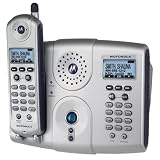
The Motorola MD671 combines 5.8 GHz digital technology, a stylish silver design, plenty of functions, and even expandability to six handsets, making it perfect for busy households. With dual keypads, dual displays (full graphic), and dual speakerphone capability, the MD671 also offers the convenience of caller ID and visual call waiting, so you always know who's calling.
The MD671 includes one handset to get you started; it houses a wealth of great features. Selectable ring tones help identify callers, while three-way conferencing makes the MD671 a great phone for business use and home use both. The convenient intercom functionality helps you stay connected. Additional handset features include redial, flash, mute, hold, and a built-in battery meter with audible and visual alert signals that let you know when power is running low.
The MD671 comes with everything you need to get started and is backed by a one-year warranty.Caller ID with visual call waiting Full keypad in base Redial, flash, hold, and mute functionality 5.8 GHz digital signal, expandable to six total handsets
Additional features for the Motorola MD671 include full keypad in base, caller ID with visual call waiting indication in handset and base (requires subscription through your local phone company).
What's in the Box MD671 base, handset, NiCD battery pack, charging transformer, telephone line cord, wall bracket, user manual, warranty information

Click here for more information about Motorola MD671 5.8GHz Cordless Speakerphone/Caller ID

0 comments:
Post a Comment